
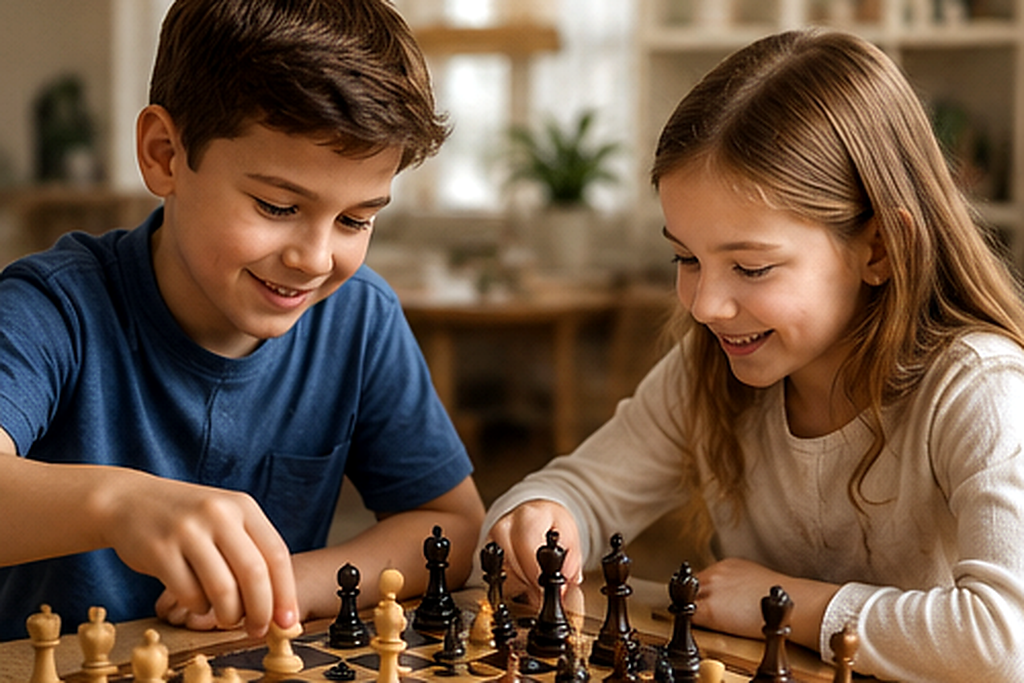
Chess can look intimidating to a beginner because thirty-two pieces, special rules, notation, tactics, and checkmate all appear at once. A better introduction is gradual. The first goal is not to play a perfect full game, but to make the board feel understandable.
Teach movement before strategy
Start with a few pieces and simple challenges. Let a rook race to target squares, ask a bishop to travel along a diagonal, or use a knight to reach a marked square in as few moves as possible. These mini-games build confidence without requiring the learner to remember every rule.
Pawns and kings can be introduced through short endgame races. Once the movement of each piece is comfortable, the full starting position becomes much less overwhelming.
Add one idea at a time
When full games begin, focus on only a few principles: develop pieces, protect the king, and notice what is attacked. Avoid correcting every imperfect move. Too much instruction can make the game feel like a test.
A clear chess set with pieces that are easy to distinguish is ideal for beginners because it reduces visual confusion. The exact style matters less than making every piece recognizable at a glance.
Small choices that make the idea work better
Chess habits grow from repeated small experiences. The themes behind “Teach movement before strategy” and “Add one idea at a time” are useful because they focus on comfort, clarity, and a manageable next step. When the first experience is easy to repeat, motivation has a chance to develop naturally instead of being demanded in advance.
For beginners, short feedback loops are especially important. A player should be able to make a choice, see the consequence, and try again without waiting through an hour-long game. Mini-games, simple positions, and brief review create that rhythm. Once the basic movements and patterns feel familiar, longer games become less mentally expensive.
Keep a small note of what people enjoyed and what they resisted. The pattern matters more than a single session. Perhaps puzzles work well but long games do not, or perhaps a child enjoys racing pieces but not formal instruction. Build on the successful format first; technique can become more demanding once the habit is established.
If the equipment or routine is shared, give everything a clear home. Pieces that are easy to find, a board that can be set up quickly, and a clock stored nearby make spontaneous games more likely. Organization matters because starting friction accumulates: a five-minute search for missing pieces can be enough to turn a possible game into something postponed until another day.
The best first lessons end while the learner is still curious. Chess is easier to love when discovery comes before memorization.