
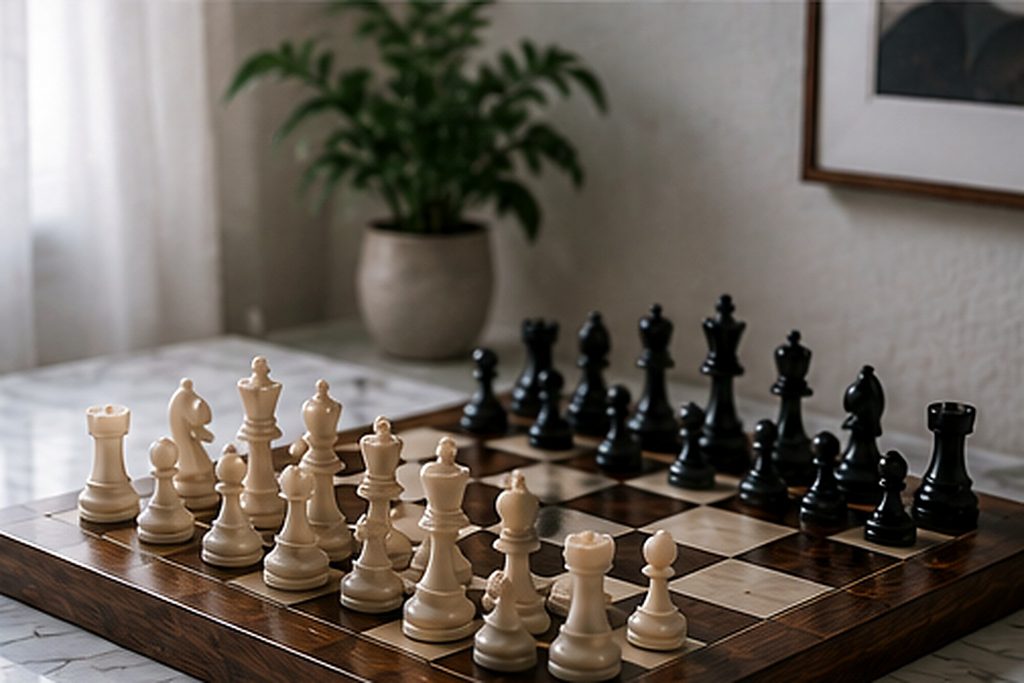
A home chess board can be decorative, practical, or both. The most important question is not which material looks most impressive, but how the board will fit into everyday life.
Match the board to the space
If the board will stay on a dedicated table, a larger fixed setup may be comfortable. If it needs to share a desk with work or study, a smaller board or folding design can make more sense. Leave enough room for captured pieces, a clock, and a notebook if you plan to analyze games.
Contrast matters more than people expect. The squares and pieces should remain easy to distinguish in normal room lighting. Very glossy surfaces can create reflections that become tiring during longer sessions.
Comfort beats display value for daily use
The best chess set for a living room is often the one people are not afraid to touch. If a set feels too delicate to move, it may become decoration rather than a game.
Weighted pieces can feel stable, while lighter sets are easier to move and store. Neither is automatically better. Think about who will use the board and how often it will be reset.
Making the idea easy to use in everyday life
Chess habits grow from repeated small experiences. The themes behind “Match the board to the space” and “Comfort beats display value for daily use” are useful because they focus on comfort, clarity, and a manageable next step. When the first experience is easy to repeat, motivation has a chance to develop naturally instead of being demanded in advance.
Physical and digital chess can be used for different jobs. A screen is convenient for quick opponents, puzzles, and records; a board is useful for slow explanation, social play, and tournament rehearsal. Choosing one format does not require rejecting the other. The useful question is which environment supports the goal of that session.
For a family or beginner session, choose one objective in advance and ignore everything else. The goal might be learning how a bishop moves, finishing a game with a clock, or reviewing one mistake. A narrow goal makes success visible and prevents the session from becoming a lecture on every rule at once.
Small environmental details can make a surprising difference. Good light, enough elbow room, a stable table, and a place to keep captured pieces all reduce distraction. None of these details improves calculation directly, but they make it easier to stay with the position. When the physical setup is comfortable, attention can remain on the game instead of drifting toward avoidable annoyances.
A home board earns its place by inviting play. The most successful setup is the one that makes starting a game feel effortless.