
Go and chess are the two most respected two-player strategy games, but they play almost nothing alike: chess is about capturing pieces to checkmate a king, while Go is about surrounding empty territory with stones. Go has vastly more possible positions, though both offer a lifetime of study.
Comparing them is less about which is "better" and more about which kind of thinking you enjoy. One rewards sharp calculation, the other broad pattern sense across a huge board.
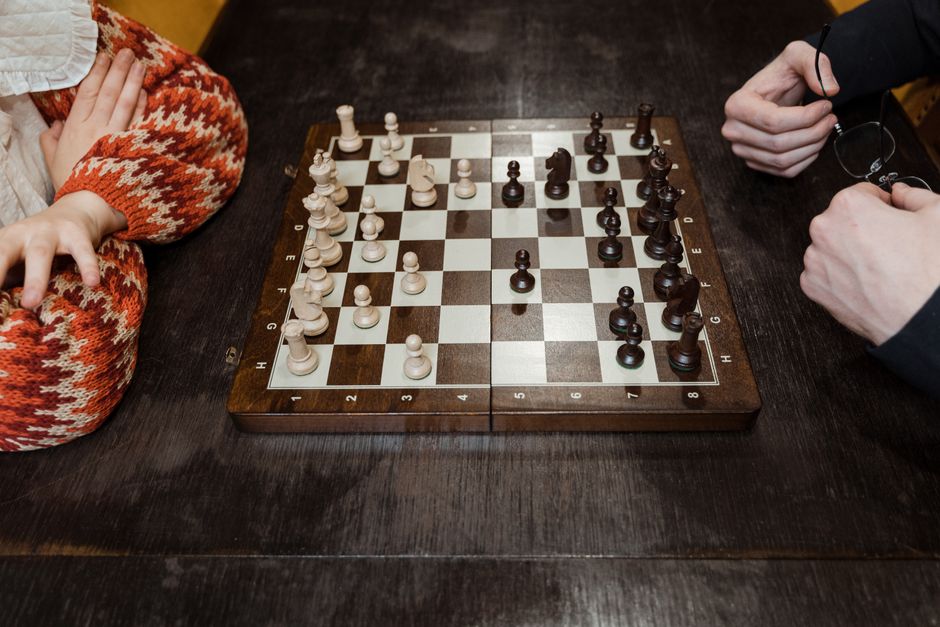
Rules and Objective
Chess uses 16 pieces per side, each moving in its own way, and the goal is to trap the enemy king. Go uses identical stones, placed one at a time, and the goal is to control more of the board.
In chess pieces move and capture; in Go stones stay put and you win by enclosing space. That single difference cascades into two utterly different strategic worlds, one about mobility and one about influence.
Here is how a typical game of each flows:
- Chess opens with development of pieces toward the center.
- The chess middlegame revolves around tactics and king safety.
- Chess endgames reduce to a few pieces and precise technique.
- Go opens by claiming corners and sides with lone stones.
- The Go middlegame is invasion, reduction, and fighting.
- Go endgames settle borders point by point.
Both games end with a clear result, but chess can end abruptly in checkmate while Go almost always runs to a full count.
Complexity and Depth

Go is played on a 19×19 grid with 361 points, dwarfing the chessboard’s 64 squares. That larger space, plus the freedom to place a stone almost anywhere, gives Go an astronomically bigger game tree.
The number of legal Go positions exceeds the number of atoms in the observable universe, far surpassing chess. This is why computers conquered chess decades before mastering Go, which required modern machine learning to reach top human level.
| Feature | Chess | Go |
|---|---|---|
| Board | 8×8, 64 squares | 19×19, 361 points |
| Pieces | 6 types, distinct moves | Identical stones |
| Objective | Checkmate the king | Surround more territory |
| Draws | Common | Almost never |
| Handicaps | Awkward | Elegant and built-in |
Do not assume skill transfers between the two. A strong chess player often starts as a raw beginner in Go, because the pattern recognition and strategic instincts are completely separate.
Go’s handicap system is famously graceful: a weaker player simply starts with extra stones, letting people of very different strengths enjoy a genuine contest.
Strategy and Thinking Styles
The mental skills each game trains barely overlap. Chess rewards precise forward calculation, where reading a forcing line five moves deep can win on the spot, and a single tactical blunder can end the game instantly.
Go rewards judgment about vague, large-scale potential, weighing influence and territory across the whole board rather than calculating one line to its end. A Go player often chooses between two moves whose value differs by only a few points, spread over regions that will not resolve for dozens of moves.
The role of sacrifice differs too. In chess, giving up material demands concrete compensation you can usually calculate. In Go, sacrificing stones to build a wall or gain influence is routine and often central to good strategy, since dead stones can still serve a purpose.
Both games share one lesson: control the balance between attack and defense. In chess you must keep your king safe while pressing the opponent, and in Go you must keep your groups alive while attacking theirs. That tension between offense and safety is the common thread that makes both endlessly rich.
History and Culture
Both games carry deep cultural roots that add to their appeal. Chess spread from India through Persia and the Islamic world into Europe, where its modern rules settled around the fifteenth century, and it became a fixture of Western intellectual life.
Go originated in China more than two millennia ago and became one of the four traditional arts a cultured scholar was expected to master, alongside music, calligraphy, and painting. It spread to Korea and Japan, where professional Go houses refined its theory over centuries into the game played today.
The professional scenes differ in flavor. Chess crowns a single world champion through a long cycle of qualifying events, and its top players are global celebrities. Go supports large professional organizations in China, Japan, and Korea, with dozens of titles and a fiercely competitive circuit across East Asia.
Both games also drove milestones in artificial intelligence. A chess engine beat the world champion in 1997, while a Go program reached the top human level only in 2016, a gap that measures just how much larger Go’s complexity is. That shared history with computing has, if anything, renewed public interest in both games rather than diminishing them.
Which Should You Learn?
Choose chess if you love concrete calculation, tactical combinations, and a massive library of study material. Openings have names, engines analyze every move, and opponents are everywhere.
Choose Go if you prefer whole-board strategy, gradual influence, and a game where every point on the board can matter at once. Go tends to feel more like painting a landscape, while chess feels like a duel.
Many players eventually learn both, since the two exercise different mental muscles. Chess sharpens forcing sequences; Go trains balance, sacrifice, and judging vague potential.
If you are still undecided, consider trying both on small boards or short time controls first. A few quick games of each will tell you more about your own taste than any comparison chart, since the feel of placing stones differs sharply from the feel of maneuvering pieces.
There is no losing choice here. Both games have thrived for centuries because they reward patience and study without ever fully giving up their secrets. Pick the one whose rhythm appeals to you, play regularly, and you will find depth enough to last a lifetime.